
Statues and sculptures
Discover Brussels' diverse public art, from pieces of the Berlin Wall to giant sculptures and graffiti, each with its own unique story.
The Berlin Wall... in Brussels
To commemorate the 20th anniversary of the fall of the Berlin Wall, sections of the Wall were brought to Brussels.
One piece can be seen on the esplanade before the European Parliament, a second is located on Rue Wiertz (also near the European Parliamant), and a third on the esplanade of the Berlaymont building.
In 2020, the Elia company also acquired a section of the wall. It is installed on its Monnoyer site, along the canal.
Monument paying tribute to Joseph Plateau
Joseph Plateau discovered the principle of persistence of vision, one of the basic principles of cinematography: our brain perceives the illusion of movement as of 24 images per second.
A monument pays tribute to him in Brussels and shows important scenes from cinema's history.
Contact us
Monument hommage à Joseph Plateau / Monument ter ere van Joseph Plateau
Rue Joseph Plateau / Joseph Plateaustraat1000 Bruxelles / Brussel
The 'lifeguard' chair
This four-metre high work of art was created by Peter Weidenbaum. At the bottom of the chair is a poem by Agnieszka Kuciak.
Contact us
La chaise de "maître-nageur" / De redderstoel
Rond-Point Montgomery et Boulevard Saint-Michel / Montgomeryplein / Sint-Michellaan1040 Bruxelles / Brussel
The Pavilion of Human Passions
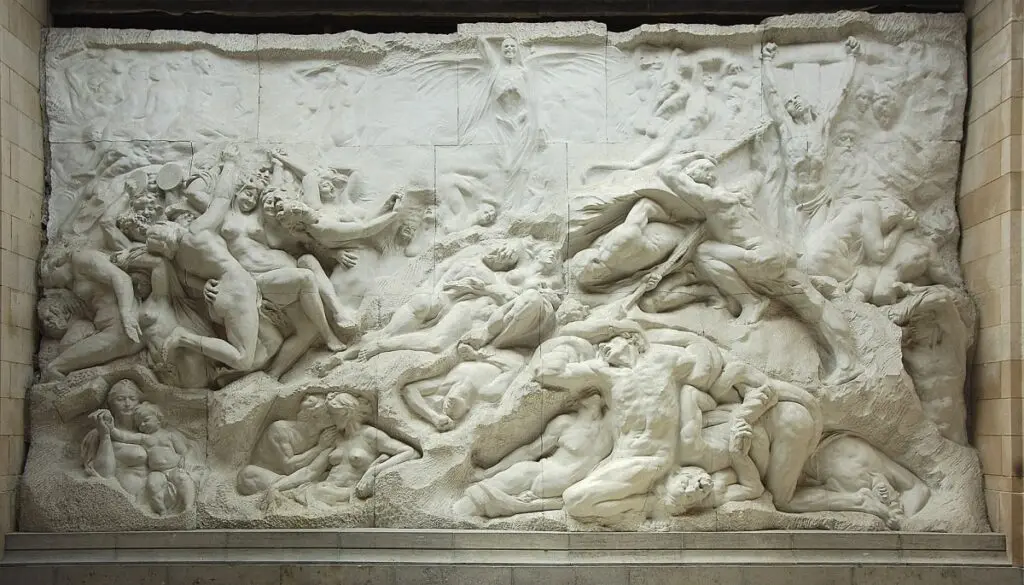
This work by Jef Lambeaux caused a scandal when it opened in 1899. Accused of being an insult to common decency (many nudes are exhibited), the work was hidden from the eyes of the general public by blocking access to the pavilion in which it was housed. Nowadays it can be visited on special occasions (including heritage days and museum open days). The building that houses the sculptures was designed by Victor Horta.
Contact us
Le Pavillon des Passions Humaines / Paviljoen van de Menselijke Driften
Parc du Cinquantenaire (côté Rond-point Schuman) / Jubelpark (rotonde Schumanplein)1000 Bruxelles / Brussel
The canopies of Brussels Town Hall
The canopies that overhang the three columns in the right part of Brussels town hall display some unexpected scenes:
- a mother breastfeeding her baby and some men in turbans
- monks clinking their beer glasses
- characters shovelling chairs.
Some think that these scenes refer to establishments that were demolished to make way for the town hall. In this reading, the monks represent a hostelry called the 'Papenkelder', the monks’ cellar. The mother and the men in turbans refer to 'De Moor' (the diminutive of the Dutch word for mother and the name of the Muslim people of northwestern Africa. The scene of men with chairs ('stoelen') and shovels ('schoppen') may be a play on words in Dutch – 'schopstoel' is Dutch for strappado, a form of torture used on condemned people on Grand’Place.
Contact us
Les chapiteaux de l'Hôtel de Ville de Bruxelles / Kapitelen van het Stadhuis van Brussel
Grand-Place1000 Bruxelles / Brussel
La Pasionaria
This is an installation by the artist Emilio Lopez Menchero. On his website the artist explains that the sculpture in the form of a megaphone 'is dedicated to all migrants and refers to Joris Ivens’ film on the Spanish civil war, which features a giant megaphone towed by a truck booming out encouragement to the Republican troops in the trenches, including La Pasionaria’s (the militant communist Dolorès Ibárruri)'. Why not climb the steps and try it out for yourself.
Contact us
La Pasionaria
Avenue de Stalingrad (Gare du Midi) / Stalingradlaan (Zuidstation)1000 Bruxelles / Brussel
Zinneke
In the Brussels dialect a ‘zinneke’ is a mongrel dog. This one on the corner of Rue des Chartreux is by the sculptor Tom Frantzen. A symbol to the multicultural character of Brussels and a tribute to Manneken Pis.
Contact us
Le Zinneke / Zinneke
Rue des Chartreux / Kartuizersstraat1000 Bruxelles / Brussel
De Vaartkapoen
Another of Tom Frantzen’s sculptures depicts a policeman about to fall head over heels at Place Sainctelette. It’s a tribute to the policeman created by Hergé in the adventures of Quick & Flupke.
Contact us
De Vaartkapoen
Place Sainctelette / Saincteletteplein1080 Bruxelles / Brussel
The statue of the soldier pigeon
Brussels is probably the only city in the world with a permanent monument to the carrier pigeons used to relay messages during the Great War. Victor Voets’ statue of the pigeon soldier was unveiled in March 1931 in honour of the pigeons, as well as the pigeon fanciers who laid down their lives between 1914 and 1918.
Contact us
La statue du pigeon soldat / De Oorlogsduif
Square des Blindés / Pantsertroepensquare1000 Bruxelles / Brussel
Madame Chapeau
A tribute to the famous character in 'Bossemans & Coppenolle', an old Belgian play.
Contact us
Madame Chapeau
Rue des Moineaux et rue du Midi / Mussenstraat en Zuidstraat1000 Bruxelles / Brussel
The caves of Lourdes... in Brussels
There are many replicas of the caves of Lourdes around the world, and Brussels has two of them: one in Anderlecht and one in Jette.
Contact us
Les grottes de Lourdes... à Bruxelles / De grotten van Lourdes... in Brussel
Rue de la Floraison / Bloeistraat1070 Bruxelles / Brussel
Contact us
Les grottes de Lourdes... à Bruxelles / De grotten van Lourdes... in Brussel
Rue Léopold Ier / Leopold I-straat, 2961090 Bruxelles / Brussel
The clock at Mont des Arts
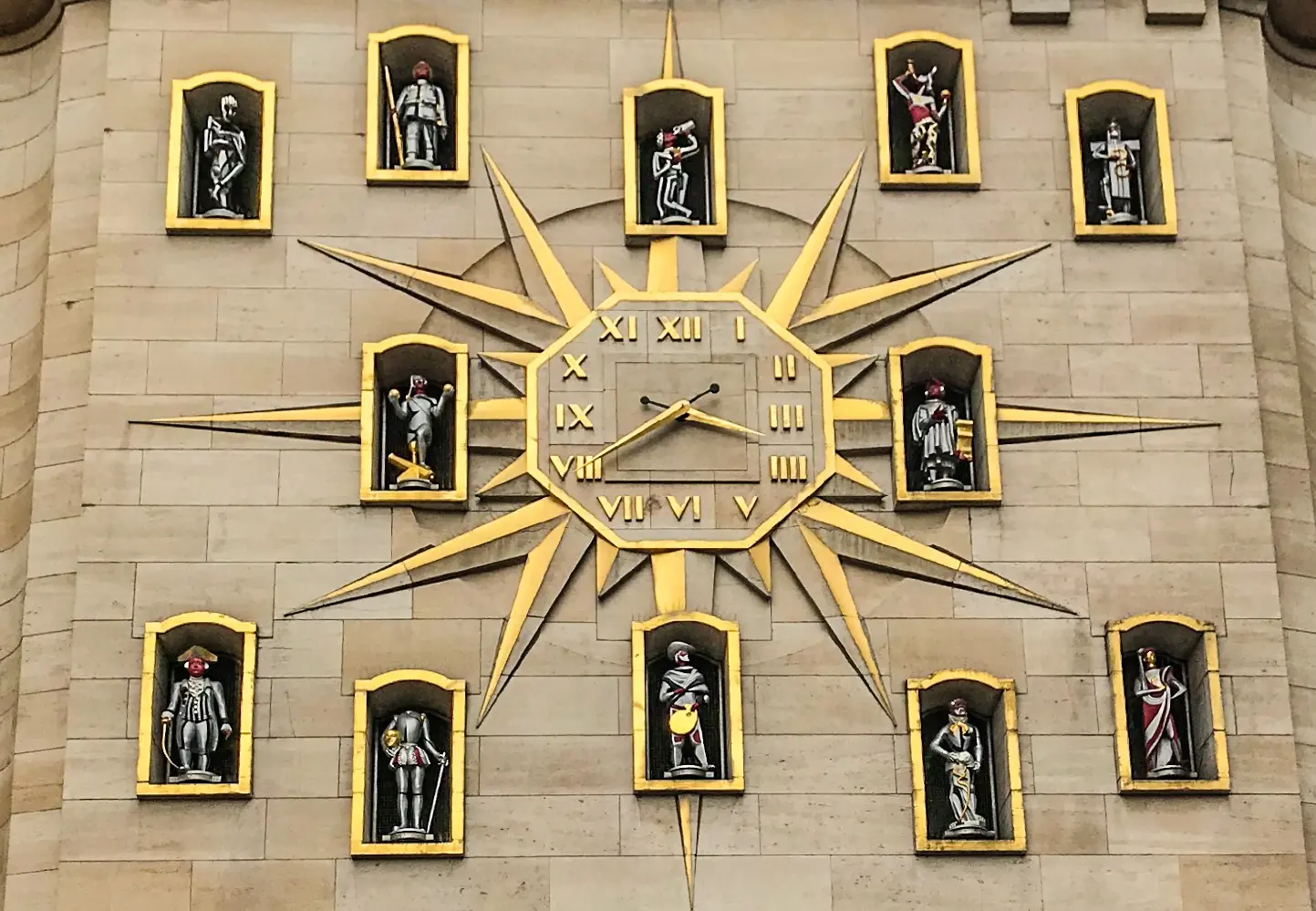
Built in 1958, the clock features various figurines marking the hours, including a labourer with his tankard, Charlier Jambe de Bois (a hero of the 1830 revolution), Charles V, Holy Roman Emperor, Rubens, the Count of Egmont and a First World War soldier.
Europe’s largest graffiti work
The Region commissioned sixty street artists to create Europe’s largest graffiti work – covering 4500 sq m over the two platforms of De Wand tram stop on lines 7 and 19.